“A Winged Ogre of Many Languages” – A Review of Abenea Ndago’s Nandi Bear (Nsemia Inc., 2025) by Dr. Charles Kebaya
February 2026
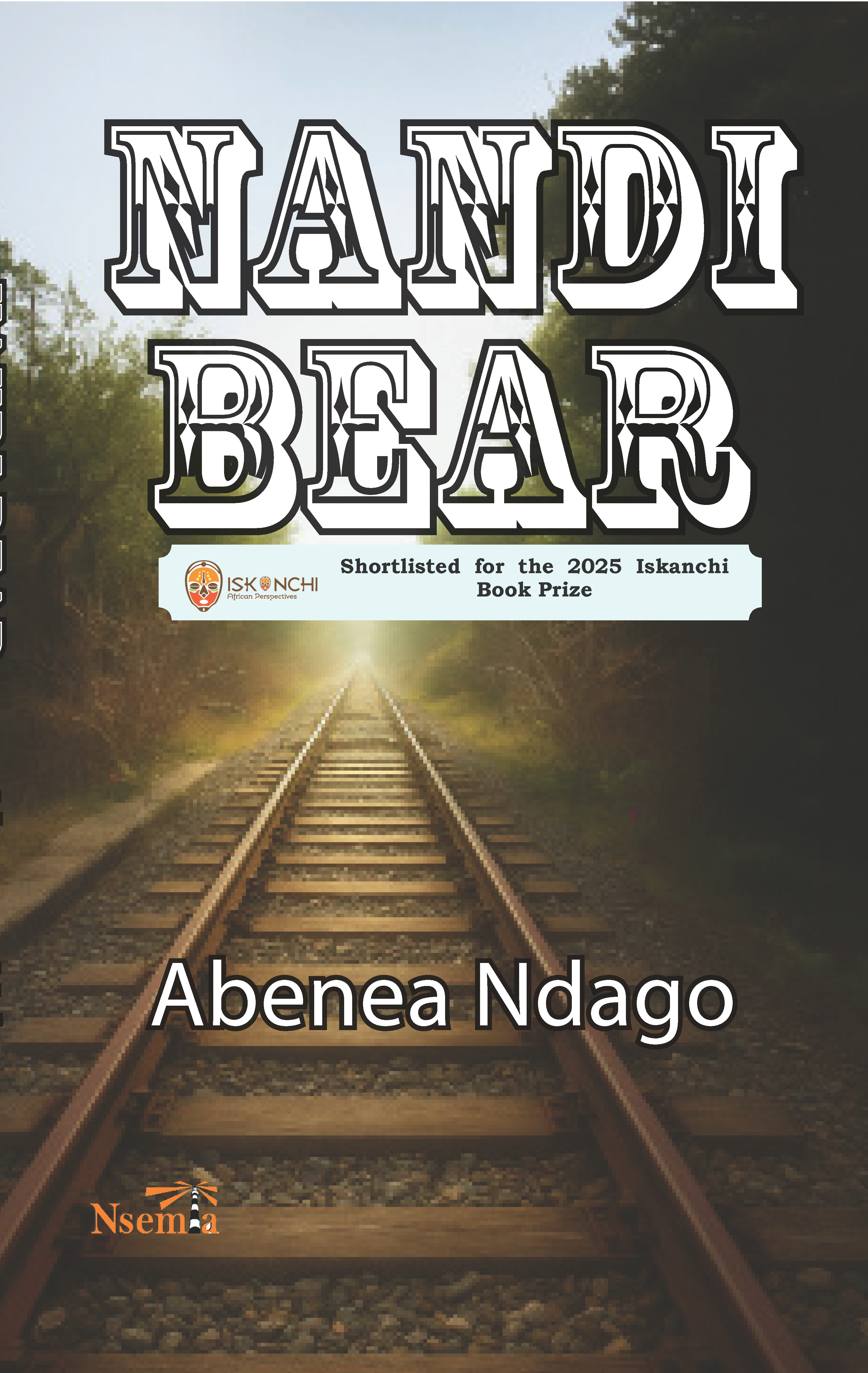
Shortlisted for the 2025 Iskanchi Book Prize for African Literature, Abenea Ndago’s novel, Nandi Bear (Nsemia Inc., 2025), clearly decentres Kenya’s narrative regarding the struggle for independence. This decision in the novel is as potent as it is political, especially if we consider that political narratives are at the centre of our country’s struggle with nationhood.
The novel blends fictional characters with real historical figures, that span pre-colonia
l and the colonial periods. The spirit of Lwanda Magere pervades the plot, and this plot spills into the struggle against colonization in Kenya through the experiences of the protagonist, a warrior band leader by the name Kwong’utiet. This results in a cyclic and multi-layered narrative with multiple subplots, each foregrounding unique political and socio-cultural issues. These combine with the human experiences in the Kenyan society at the time.
Myths, totems and oral traditions form the canvas upon which the story of the Nandi Bear is told. The novel is couched in the ordered traditional African cosmos, where the supernatural interacts with the human and controls human life. Just like Edgar Mittelholzer’s novel, My Bones and My Flute (1955), Ndago blends European spirits, represented by Mr. Perry, with a mysterious local spirit, the chemosit, to expose colonial evils and critique the lasting impact of Arab and European activities in the country. These evils include slavery, colonialism, and the imposition of new religions. Through Kwong’utiet, the narrative focaliser, Ndago shows the excruciating disruption and trauma that Africans underwent during pre-colonial and colonial penetration of their lands by Arabs and Europeans via slavery and the building of the railway line from Mombasa to Port Florence (Kisumu) between 1896 and 1901.
Kenyan literature has always ignored the effects of the rinderpest plague that decimated livestock in Eastern Africa around 1897. Ndago’s novel confronts this decisive historical occurrence by showing how the rinderpest plague and the subsequent poor harvest in Kipsisin serve as precursors to the tough times that Africans would endure at the hands of the European colonizers. This becomes apparent with the shooting to death of Boiyot at Ketbarak, near present-day Nandi Hills, and the eventual banishment of the character’s entire community from Kipsisin in the then Kavirondo (Nyanza and Western Kenya) to Gwassi in today’s Homa Bay County.
Symbolically, Ndago references the beheading of Koitalel Arap Samoei and the banishment of the Kenyan hero’s family to Gwassi by the British in the very early twentieth century. The author beautifully brings this home by weaving the novel through the experiences of Boiyot’s clan as they move from Kipsisin to Gwassi.
Nandi Bear is an important decentring act in the sense that it goes against the grain of the official Kenyan narrative about the struggle for independence. If the official narrative leans heavily towards the Mau Mau and Dedan Kimathi, then Ndago’s book centres countless other forgotten actors. These heroes and heroines of the struggle for liberation in Kenya include Otenyo, Ojijo Oteko (the one after whom Ojijo Road is named), Daudi Wabera (Wabera Street), Mekatilili Mensa, Lukas Pkech, and the late Kenyan politician Esau Khamati Oriedo of Luanda Town.
Yet the novel does not seem to silence the history of Central Kenya. Prominent recognizable characters such as Tuku (Harry Thuku), Ohiki (Jomo Kenyatta), Wardei (Dedan Kimathi), Mbichi (Rawson Macharia) and a certain mysterious woman (possibly Nyanjiru) are at the centre of the plot. Nandi Bear boldly asks the country to reconsider how it archived crucial colonial history that refers to the former list of heroes and heroines. How do we remember, if we have erased the contributions of other communities in the struggle for independence? In a country where history is an important political premium, Ndago shows us the effects of erasing different communities’ political histories and how this skews national discourse. The novel gathers all those who were meant to be forgotten and refuses their erasure. A pessimist might even say that the novel presents an alternative to the grand Mau Mau narrative and nudges readers to reconsider the historization of Kenya’s struggle for independence.
While Ndago explores various themes in Nandi Bear, loss is prominent. There is a great loss in the narrative, both at the collective and personal levels. The loss of a communal way of life, culture, beliefs and traditional practices through Arabic and Western religions and the loss of communal land and African systems of governance as a result of Arab slave trade and European colonization represent collective loss and are devastating to Africans. At a personal level, Kwong’utiet loses “the mother of his hut”, Jematia, as well as his daughter, Chepto, and his brother, Boiyot. The combined personal losses amount to a great collective loss to the wider community. Ndago pokes readers to imagine what communal loss meant then, what it means now, and what we as people do with that loss. Heartbreaking as it is, this great loss is shown to serve a purpose in the ways it brings people together. The reader comes to understand that, in the unity of loss, people can forge a community through hope.
The author employs a simple, candid and accessible language to present the story and various historical events in Nandi Bear. In fictional narratives which give a historical account of events, authorial intrusion can emerge, and, though useful when applied with tact, it can stand in the way of the story. This is not the case with Nandi Bear as Ndago weaves historical realities into the narrative in a fascinating way. He combines the strategy of concealment, personification, juxtaposition, verisimilitude and stream of consciousness in the rendition of his story, and to enhance the narrative. Ndago’s use of local names for the characters, trees, places and spirits gives the narrative authenticity and local colour.
Kenyan scholars, researchers and students of literature, history, cultural and memory studies will find Nandi Bear an invaluable novel for understanding the path we travelled in the struggle for independence.
Dr. Charles Kebaya teaches Literature at Machakos University.